Gravel
How Deep Should a Gravel Driveway Be?
Recommended gravel driveway depths for new builds, soft soils and resurfacing, with layer-by-layer guidance and the volume impact of each extra inch.
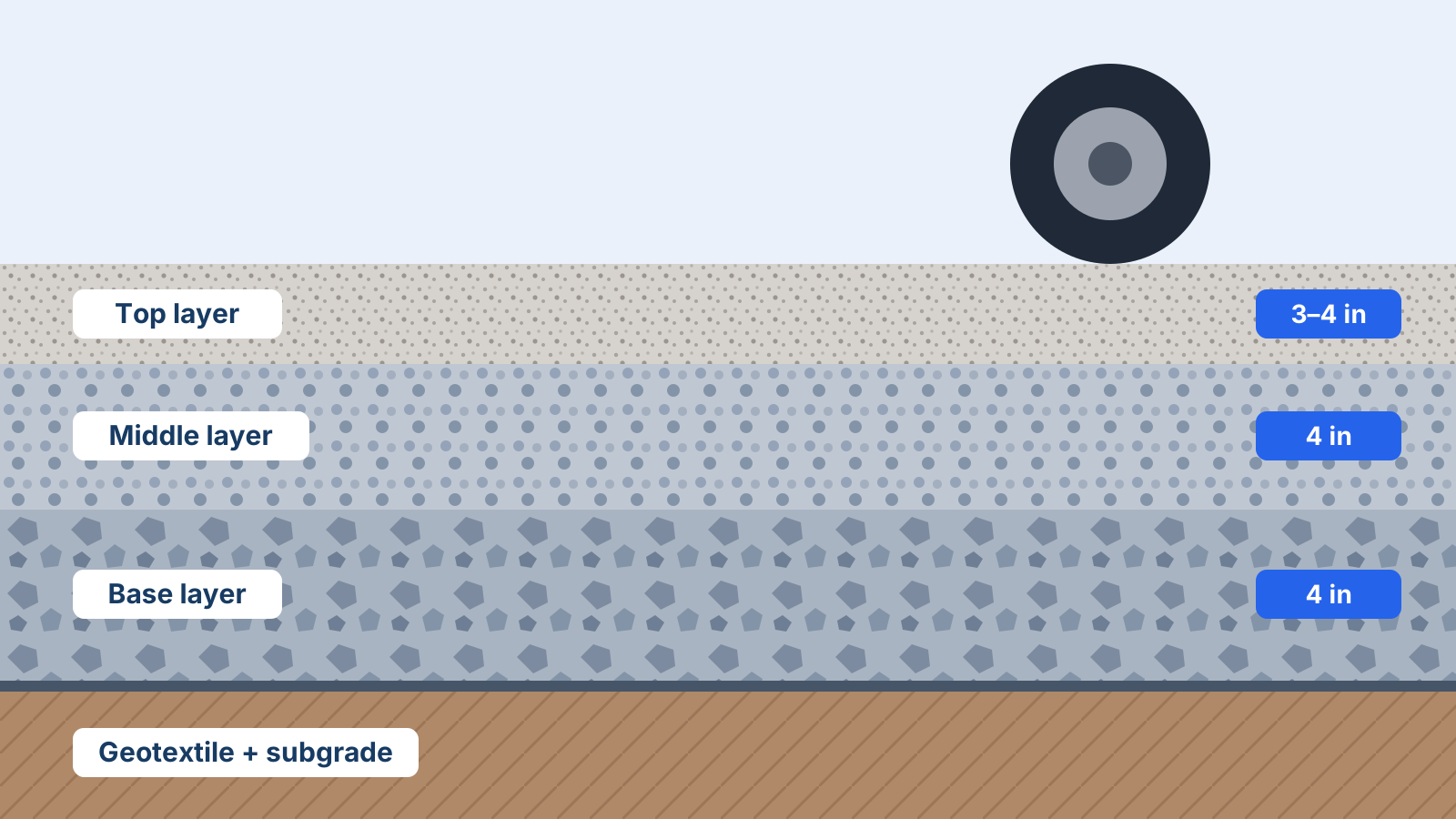
Most gravel driveway problems — ruts, potholes and stone disappearing into mud — come from a base that is too thin for the soil underneath. Depth is what turns loose stone into a surface that carries vehicles.
Here is a practical look at how deep each layer should be and when to go deeper.
The general guideline
For a new gravel driveway on reasonably firm soil, a total compacted depth of around 8–12 in (20–30 cm) is a widely used guideline, built in two or three layers of roughly 4 in each.
| Situation | Typical total depth |
|---|---|
| Firm, well-drained soil, cars only | 8 in (20 cm) |
| Average soil or occasional heavier vehicles | 10–12 in (25–30 cm) |
| Soft clay, poor drainage, trucks | 12 in+ with geotextile |
| Resurfacing an existing driveway | 2–3 in (5–8 cm) top layer |
These are typical ranges. Your soil, climate and vehicles matter more than any single number. A local contractor or supplier can advise based on conditions in your area.
Why build in layers?
Large angular stone at the bottom locks together to carry load and let water drain. Smaller stone in the middle fills the gaps. The top layer contains fines that bind when compacted to create a firm driving surface.
Compacting each layer separately, rather than dumping all the stone at once, gives a much stronger result. Most plate compactors work best on lifts of about 4 in.
When to go deeper
- Clay or silty soils that turn soft when wet.
- Poor drainage, where water sits on the surface after rain.
- Heavy vehicles such as delivery trucks, RVs or tractors.
- Cold climates with frost heave.
In these cases, excavating deeper and laying a woven geotextile under the base keeps the stone from mixing with the soil.
What an extra inch costs
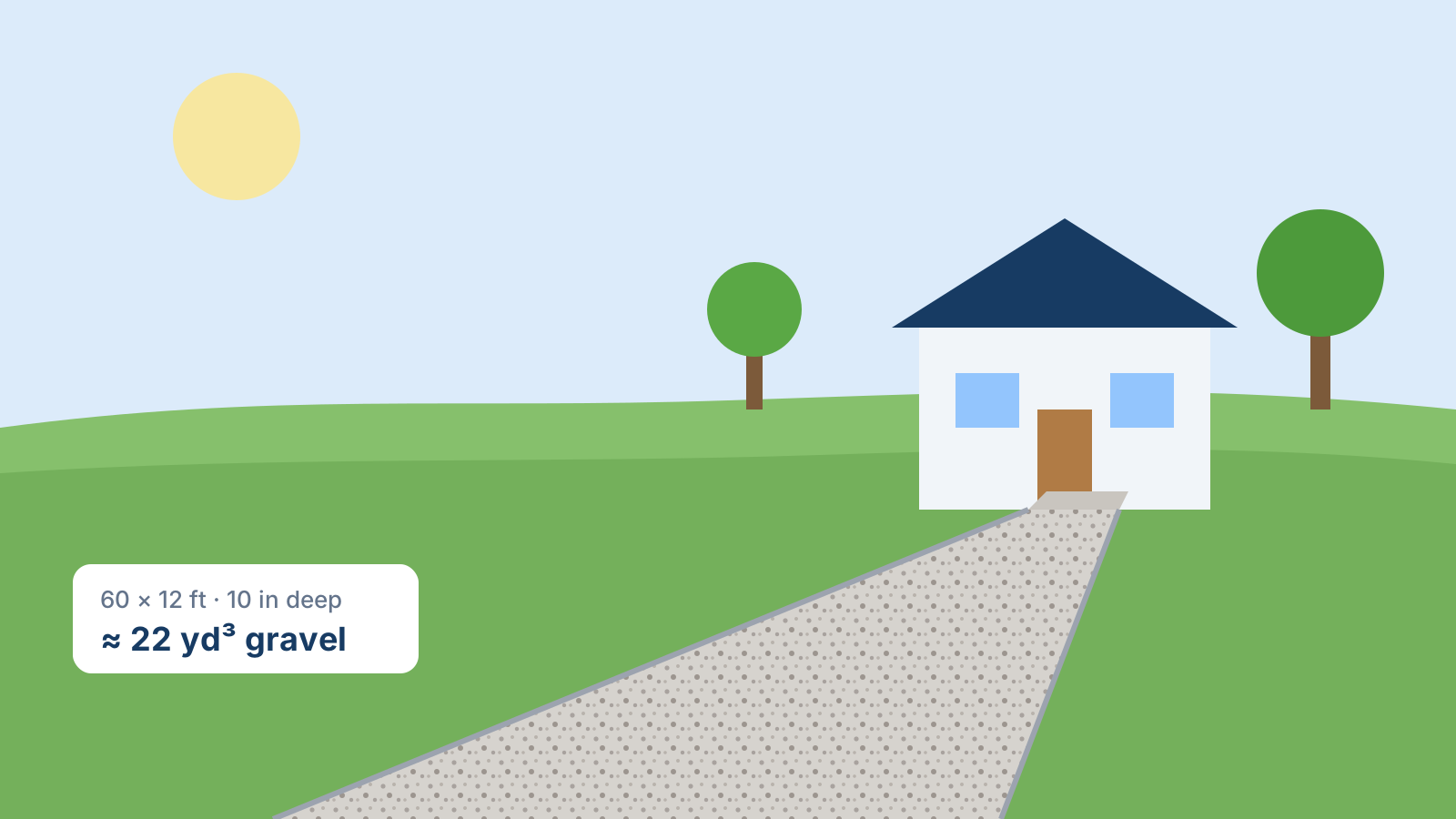
Every inch of depth on a 60 × 12 ft driveway (720 ft²) adds about 2.2 yd³, or roughly 3.1 tons at 1.4 tons/yd³.
| Total depth | Volume | Approx. weight |
|---|---|---|
| 8 in | 17.8 yd³ | 24.9 tons |
| 10 in | 22.2 yd³ | 31.1 tons |
| 12 in | 26.7 yd³ | 37.3 tons |
Use the driveway gravel calculator to try different layer depths with your own dimensions.
Try the Driveway Gravel Calculator
Layer-by-layer gravel quantities for a new or resurfaced gravel driveway.
Frequently asked questions
Is 4 inches of gravel enough for a driveway?
4 in is usually enough only as a top-up over an existing, well-compacted base. A new driveway on bare soil generally needs much more.
How often does a gravel driveway need new gravel?
Many owners add a thin top layer every few years as stone gets pushed aside or worn. Good drainage and a solid base reduce how often this is needed.
About the author
Written by the BuildCalcWorld Editorial Team. Our guides explain standard estimating methods with worked examples you can verify. Material properties vary by product and region, so always confirm specifications with your supplier. Published . Learn more about us.
Related articles
 Gravel
How to Calculate Gravel for a Driveway
Step-by-step guide to calculating driveway gravel in cubic yards and tons, including layers, compaction and converting volume to weight with real examples.
2 min read Pavers & Hardscaping
How to Calculate Paver Base Material
Learn how to calculate paver base gravel and bedding sand, choose the right base depth, account for compaction and convert to tons for ordering.
2 min read