Concrete
Concrete Slab Thickness: A Practical Guide
How thick should a concrete slab be? Practical thickness ranges for patios, walkways, shed bases, driveways and garage floors, plus how thickness affects cost.
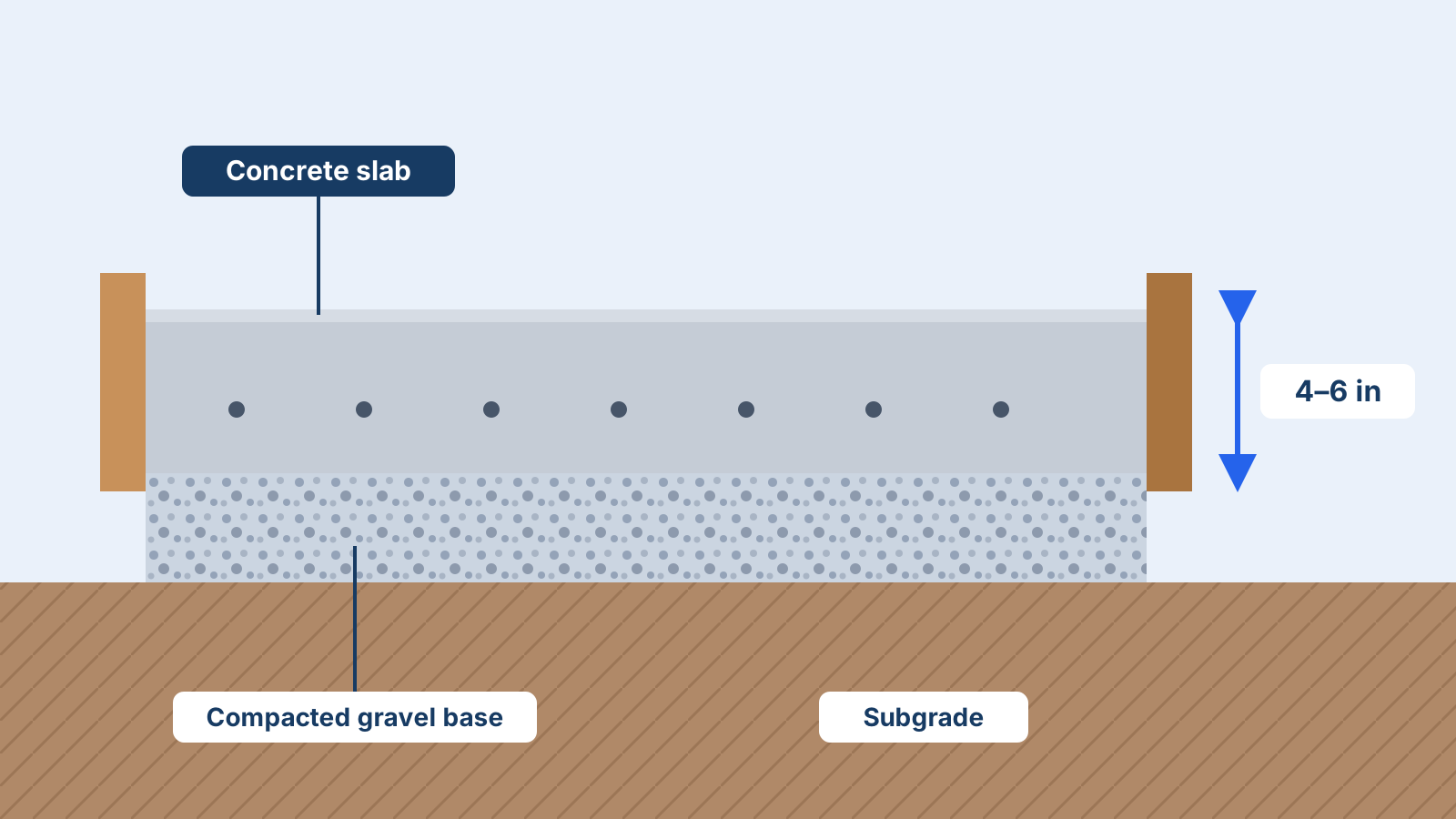
Thickness is the single biggest factor in how much concrete a slab needs, and one of the most important factors in how long it lasts. Going from 4 to 5 inches adds 25% to the concrete bill; going too thin can mean cracked, sinking slabs within a few years.
This guide gives commonly used thickness ranges for typical residential slabs and explains the factors that should push you thicker. It is general guidance only, so always follow local codes and any engineer's design.
Typical slab thicknesses
| Use | Typical thickness | Notes |
|---|---|---|
| Walkways and paths | 4 in (100 mm) | Foot traffic only |
| Patios | 4 in (100 mm) | Thicker under hot tubs or heavy planters |
| Shed bases | 4 in (100 mm) | Often with thickened edges |
| Driveways (cars) | 5–6 in (125–150 mm) | 6 in for heavier vehicles |
| Garage floors | 4–6 in (100–150 mm) | Depends on vehicles and local code |
| RV or heavy equipment pads | 6 in+ (150 mm+) | Usually needs engineering input |
These ranges are typical, not universal. Soil, climate, loads and local building codes can all require thicker slabs or specific reinforcement.
What affects the right thickness?
Load
Foot traffic needs far less than a delivery truck. Concentrated loads, such as hot tubs, vehicle jacks or shelving posts, can crack a slab even when the average load is low.
Subgrade and base
A slab is only as strong as what is underneath. A well-compacted granular base spreads the load and reduces settlement. On soft clay, a thicker base often does more good than a thicker slab. See how to calculate base material for base depth guidance.
Climate
Freeze-thaw cycles and de-icing salts are hard on concrete. In cold climates, air-entrained concrete and good drainage matter as much as thickness.
Reinforcement
Rebar or wire mesh helps hold cracks tight but does not replace adequate thickness or a good base.
How thickness affects cost
Volume scales directly with thickness. For a 20 × 20 ft slab:
| Thickness | Volume | With 10% waste |
|---|---|---|
| 4 in | 4.94 yd³ | 5.43 yd³ |
| 5 in | 6.17 yd³ | 6.79 yd³ |
| 6 in | 7.41 yd³ | 8.15 yd³ |
Each extra inch on this slab adds about 1.2 yd³ of concrete. Use the concrete slab calculator with your local price per yard to see the cost difference.
Try the Concrete Slab Calculator
Volume in cubic yards and metres plus the number of pre-mixed bags for patios, pads and floors.
Thickened edges and footings
Many slabs, especially for sheds and garages, have a thickened perimeter that acts as a footing. Calculate the main slab at its normal thickness, then add the extra depth around the edge as a continuous footing.
Example
Thickened edge on a 12 × 16 ft shed slab
- Perimeter: 2 × (12 + 16) = 56 ft
- Extra edge: 12 in wide × 8 in deeper than the slab
- Volume: 56 × 1 × 0.667 = 37.3 ft³ = 1.38 yd³
Result: Add about 1.4 yd³ to the slab volume for the thickened edge.
Frequently asked questions
Is 4 inches of concrete enough for a driveway?
4 in is sometimes used for light cars on excellent bases, but 5–6 in is more commonly recommended for driveways because of the concentrated wheel loads.
Is a thicker slab always better?
Not necessarily. Beyond what the load requires, extra thickness mainly adds cost. A well-prepared base, proper joints and good curing often matter more.
How thick should a hot tub slab be?
Hot tub manufacturers usually specify the pad, often at least 4–6 in of reinforced concrete. Follow the manufacturer's installation guide.
About the author
Written by the BuildCalcWorld Editorial Team. Our guides explain standard estimating methods with worked examples you can verify. Material properties vary by product and region, so always confirm specifications with your supplier. Published . Learn more about us.
Related articles
 Concrete
How Much Concrete Do I Need for a Concrete Slab?
Learn how to calculate concrete for a slab step by step, convert to cubic yards or cubic metres, add the right waste allowance and decide between bags and ready-mix.
3 min read Concrete
 Bags Calculator: How Many Bags Do You Need?
Understand concrete bag yields, convert volume into bags, and compare 40, 60 and 80 lb bags (and 20–30 kg bags) with worked examples and a quick reference table.
2 min read